
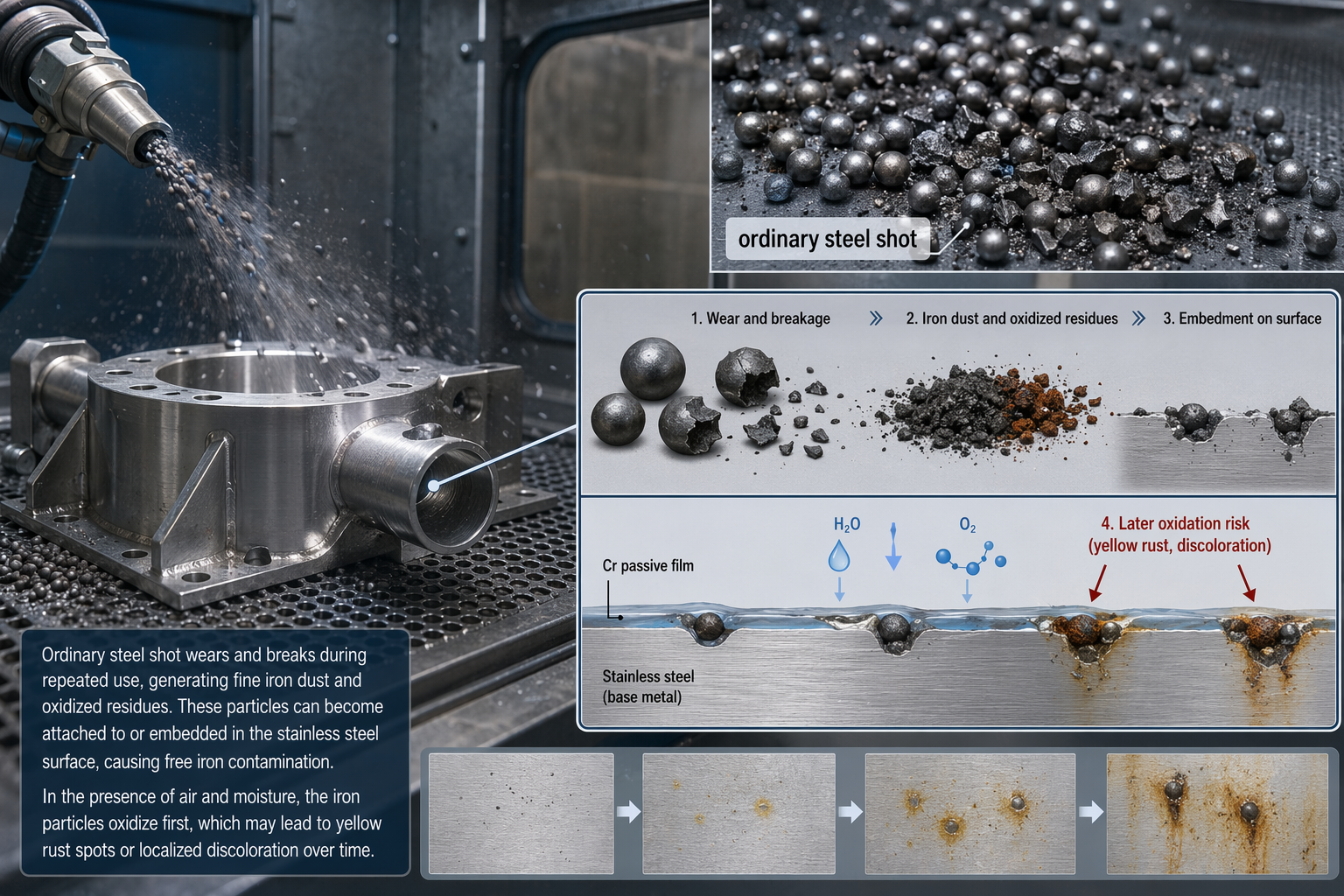
Surface Contamination Risk
In surface treatment facilities, many people judge whether an abrasive is suitable based on cleaning efficiency and cost. But for stainless steel workpieces, whether it "can blast effectively" is not the most critical issue - what really needs attention is the surface contamination risk.
Nature of Regular Steel Shot
Regular steel shot essentially belongs to carbon steel or low-alloy steel abrasives, with iron as the main component. During blasting and recycling, particles continuously wear and break, producing fine iron powder and oxidation residue. Once these substances attach or embed into stainless steel surfaces, they can form typical free iron contamination.
Stainless Steel Corrosion Resistance Principle
The reason stainless steel resists corrosion lies in its chromium (Cr) content. Chromium forms a stable passivation film on the surface, which is the foundation of its corrosion resistance. However, if foreign iron particles mix into the surface, they tend to oxidize first under air and moisture. The yellow rust spots seen are often not the stainless steel itself rusting, but iron contamination from regular steel shot.
This explains why some workpieces appear normal immediately after treatment, but develop rust spots, yellowing, or local discoloration after being stored for a period. For high-quality stainless steel workpieces, such issues not only affect appearance but may also impact subsequent acid passivation, electropolishing, coating adhesion, and customer acceptance results.
Scenarios Where Regular Steel Shot Should Not Be Used
Based on our years of application experience, the following scenarios especially should not casually use regular steel shot:
- Stainless steel decorative parts
- Food equipment and kitchenware components
- Medical or high-cleanliness requirement parts
- Export-grade stainless steel products
- Workpieces requiring subsequent passivation, coating, or finishing treatment
It should be noted that this doesn't mean regular steel shot absolutely cannot contact stainless steel under any circumstances. Rather, for scenarios with requirements for surface cleanliness, corrosion resistance, and subsequent processes, casual mixing is not recommended.
Safer Approaches
A safer approach is to select more suitable abrasives based on workpiece requirements, such as stainless steel shot, glass beads, or other low-contamination media. Meanwhile, equipment, recycling systems, and storage management should be separated as much as possible to avoid cross-contamination.
Abrasive Selection Recommendations
| Workpiece Type | Recommended Abrasive | Reason |
|---|---|---|
| Stainless decorative parts | Stainless steel shot (304/430) | Avoid iron contamination, maintain surface cleanliness |
| Food equipment | Stainless steel shot (304) | High cleanliness requirements, no iron contamination risk |
| Medical parts | Stainless steel shot or glass beads | Low contamination, meets cleanliness standards |
| Export products | Stainless steel shot | Avoid subsequent acceptance issues |
| Passivation/coating workpieces | Stainless steel shot or glass beads | Ensure subsequent process effectiveness |
Equipment Management Points
- Separate equipment use: Stainless steel treatment equipment separate from regular steel equipment
- Isolated recycling system: Abrasive recycling systems should not be mixed
- Separated storage: Different abrasives stored by category, avoid confusion
- Regular cleaning: Clean residual abrasive inside equipment periodically
Summary
Surface treatment may seem like "blasting surfaces", but essentially it's about controlling material condition. For stainless steel workpieces, the risk of regular steel shot is often not immediate, but appears later. Truly professional process management doesn't just look at treatment efficiency, but examines whether the final surface is stable, clean, and can withstand time and customer inspection.
Technical Support: We provide 304, 410, 430 stainless steel shot and glass beads as low-contamination abrasives, offering selection advice based on your workpiece requirements to ensure stainless steel surface treatment quality.
Original article by EuroBlastTech, please cite source when reproducing.